

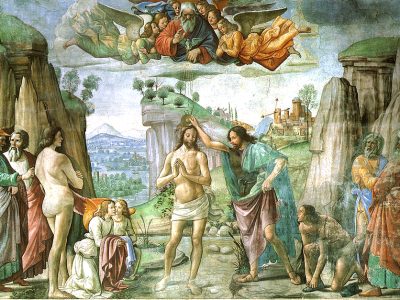
Baptism
We declare the gospel message when we enter the waters of baptism. Jesus died for our sins, was buried, and rose from the dead. By participating in baptism, we identify with Him. According to Romans 6:4, we have been buried with Him by baptism into death. We are no longer subject to the power of sin. Raised from the water symbolises our new life in Christ and our relationship with Him.
Baptism and Its Meaning
If one word could sum up the significance of baptism, it would be identification. Baptism primarily refers to a personal, public affiliation with Jesus Christ.
The Apostle Paul describes it thus way in Romans 6:3-4:
Don't you realise that when we were baptised into Christ, we were also baptised into his death? We were thus buried with him in baptism into death, so that, just as Christ was resurrected from the dead by the glory of the Father, we may also live a new life.
Take note of the emphasis on the phrases "baptised into Christ," "baptised into His death," and "buried with Him in baptism." Someone might argue that the primary allusion here is to Spirit baptism. True, but at the very least, water baptism is mentioned in this chapter.
How significant is your baptism? It is your personal identification with the greatest act of human history—Jesus Christ's death, burial, and resurrection. Baptism does not save you; salvation comes only through faith (Ephesians 2:8-9). When you trust in Christ, your sin before God is gone. But baptism is your personal witness to, and inner confirmation of, your transition from the old to the new life...
How Baptism Relates to Jesus
1. It indicates we have moved from a life of sin to a life of righteousness in Jesus Christ.
2. It signifies that we are openly identifying with Christ's death, burial, and resurrection.
3. It signifies that we are openly entering the ranks of Christians.
You are visually preaching the gospel when you are baptised. As you wait to be baptised in the water, you first represent Jesus dying on the cross. Second, as you are dropped into the water, you represent Jesus being buried in the tomb. As you emerge from the sea, you represent Jesus rising from the dead.
And by getting baptised, you are also declaring, "I died with Jesus Christ, was buried with Him, and now I am raised with Christ to a brand-new life."
In summary, you are confessing your religion through baptism without using any words. And your baptismal confession will be more successful with your friends than any sermon the pastor speaks on Sunday morning because it comes straight from you.
The verb baptizo is translated as "baptise" in Greek. The basic definition, according to most modern dictionaries, is "to dip, plunge, or immerse." The secondary definition is "bring under the influence." "After making allowances for certain occasional exceptions, such as passages where washing is implied," Dr. Merrill Tenney writes, "the etymological meaning indicates that baptism was originally by immersion." (Page 257 of Basic Christian Doctrine)
Baptism in the New Testament: Water is required for baptism. Matthew 3:21
"I do baptise you with water for repentance, but He who comes after me is mightier than I, and I am not worthy to carry His sandals." He'll baptise you with the Holy Spirit and with fire."
Water was needed for baptism. (John 3:23)
"John was also baptising at Aenon near Salim, because there was plenty of water there, and people were flocking to be baptised."
Baptism necessitates immersion in water. (Acts 8:38-39)
"And he ordered the chariot to come to a halt, and Philip and the eunuch both went down into the water, and he baptised him."
When they emerged from the water, the Spirit of the Lord took Philip away, and the eunuch saw him no longer and went on his way rejoicing."
Coming up out of the water is required for baptism. Acts 8:39 (Matthew 3:16)
Furthermore, the Apostle Paul's patterns of speech are consistent with immersion. Baptism is referred to as a "burial" in both Romans 6:4 and Colossians 2:12. Baptism takes a person "into his death" and entails being "raised to walk in newness of life." It's hard to imagine how sprinkling or pouring could express these concepts.
Finally, church history confirms that immersion was the technique of baptism practised in the early church.
Is it necessary for Christians to be baptised?
Charles Stanley explains the significance of baptism as follows:
"Our Saviour urges us to imitate Him in everything, including baptism: According to Matthew 28:19, "Go therefore and make disciples of all nations, baptising them in the name of the Father and the Son and the Holy Spirit." Jesus opted to be baptised at the start of His public career. John the Baptist was calling on the Jewish people to confess their sins and show repentance by immersing themselves in the Jordan River. The sinless Jesus joined the crowd at the river and requested that John baptise Him. The Lord chose to be associated with sinful man. We are openly proclaiming our faith in the Saviour and identifying ourselves with Him when we follow His example in the waters of baptism.
Baptism demonstrates our relationship with Jesus and our brothers and sisters in Christ. We are all members of the same body, subject to the same Lord. However, Ephesians 2:8-9 states that faith in Jesus Christ is the only necessary for salvation, not baptism. But, in order to satisfy His word, we must be baptised after making the decision to accept Him into our lives."
Important Bible Verses on Baptism
"Repent and be baptised in the name of Jesus Christ for the forgiveness of your sins, and you will receive the gift of the Holy Spirit," Peter said to them. (Acts 2:38)
And why are you still waiting? 'Rise, get baptised, and wash away your sins in his name.' (Acts 22:16)
Baptism, which corresponds to this, now saves you through the resurrection of Jesus Christ, not as a clearance of dirt from the body, but as an appeal to God for a good conscience (1 Peter 3:21).
"Truly, truly, I say to you, unless one is born of water and the Spirit, he cannot enter the kingdom of God," Jesus said. (John 3:5)
The Parable of the Wedding Feast and Baptism
In Matthew 22:1-14, Jesus relates a parable about a king who is hosting a wedding dinner for his son. The initial guests do not reply positively, so servants are dispatched to the outside of the kingdom to invite everyone they come across. The feast is packed, but there is one more phase in the parable. The king comes across one guest who is missing a bridal gown. The guest gets removed from the celebration because he cannot explain why he is missing one. This parable can truly provide us with some profound insights regarding our baptism! (Because this is a lengthier post, if you just want the overview, scroll down...)
Baptism is the gateway to the kingdom of God. It heals the original sin wound, forgives personal sin, and raises us to supernatural life. We refer to ourselves as God the Father's child, Christ's brother or sister, and the Holy Spirit's temple. However, some have raised concerns about our practise of baptism over the years, so let us consider how we may utilise this parable to clear up any confusion.
First, some have argued that baptism emphasises human work in salvation, implying that baptism saves them rather than God. Instead, they would contend that we are saved solely via faith. Giving baptism such emphasis was a later deviation from the Gospel doctrine. It would be the equivalent of inviting ourselves to the king's supper.
In contrast, we think that God's action is central to baptism. God extends the invitation freely, and baptism is our response. Furthermore, baptism is not a response that we invented. It is the covenant symbol established by God to provide this mercy. Before the Ascension, Christ explicitly teaches it (Matthew 28:19), and it is the advice Peter offers on Pentecost when the people enquire what they should do: "repent and be baptised" (Acts 2:37-38). Similarly, after hearing Philip explain the Gospel, the Ethiopian asks whether he can be baptised (Acts 8:35-36). In this first generation of the Church, baptism was included as part of the fundamental preaching. Furthermore, they refer to baptism as more than just a symbol. It has the ability to save: "This foreshadowed baptism, which now saves you." It is not a cleansing of the body, but an appeal to God for a clean conscience through the resurrection of Jesus Christ" (1 Peter 3:21). Again, the priority we place on baptism stems from the Gospel, not from human tradition. God provides us the "wedding garment" (to use the parable's image) through baptism. It is not founded on superstition (that specific deeds will force God to do something), but on God's covenantal promise (that he will be true to this sacrament). The sacrament's grace comes from God, not from the human minister.
Another frequently asked question is about baby baptism. Why do we baptise those who do not understand or consent to the meaning? Another instance of the Catholic focus on divine initiative may be seen here. God's grace is a free gift, and Scripture demonstrates his readiness to bless even small children. Jesus chastises his disciples for stopping small children from approaching him for a blessing (Mark 10:13). The Bible mentions entire families being baptised (e.g., Acts 16:33, Acts 18:8). Paul also draws a connection with circumcision, which was celebrated on the eighth day following birth (cf. Colossians 2:11-12). Finally, we can consider the witness of the early Church, where child baptism was clearly practised without raising the objection that it was contradictory to the apostles' teaching.
A last issue may arise as a result of this: what about the child's freedom? Similarly, what about the independence of a baptised adult? Is it possible to lose something that God freely offers us? This claim is frequently phrased as "once saved, always saved."
Here comes the final section of our wedding feast narrative, in which the monarch eliminates a guest for not wearing a bridal gown. The monarch approaches the visitor and gives him an open invitation to explain himself, but the visitor remains silent. It's not because he couldn't afford to buy a garment (the monarch gave it to him), or that it was stolen against his will (real sin necessitates freedom). The guest is constrained to quiet since, in reality, he has agreed to its loss. Among his numerous concerns, he did not place enough emphasis on it. Similarly, the grace of baptism is a relationship given to us. It is symbolised in the baptism ritual by the white clothing worn by the person—a direct connection to the "wedding garment." We do not baptise those without the expectation that they will be raised in an atmosphere that fosters this bond. A child has the option to accept or reject this grace later in life. We do not condemn parents for attempting to start an infant on a nutritious diet, even if the youngster eventually rejects it and chooses junk food. A parent cannot choose to raise a child in an empty setting, therefore baptism gives a context of grace and blessing that the individual might later embrace or reject.
We do not also re-baptize anyone who has "lost" this garment. Rather, we think that it is restored via repentance, particularly through the sacrament of Reconciliation/Confession, sometimes known as the "baptism of tears." This emphasis on a single baptism was also reflected in the early Church's Creed. Baptism, like marriage, initiates a bond that must be maintained. A couple will have problems if they believe their relationship would not require additional work after the wedding! They keep their pledges day after day, but they don't have to remarry after a fight. Baptism establishes a permanent relationship while still respecting our freedom and requiring a response.