

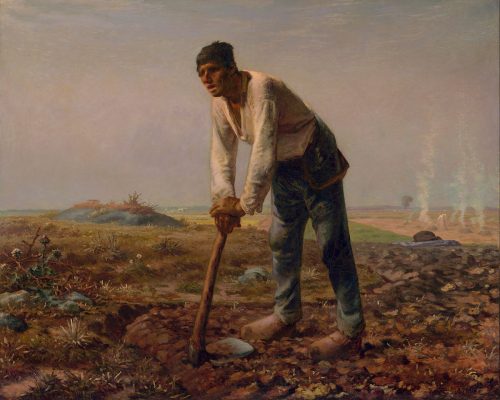
Soil Types
In the Parable of the Sower, Jesus depicts four sorts of heart soils by depicting a farmer spreading his seeds in four different types of soil:
Good Roadside Soil Rocky Soil Thorny Soil
A "parable" can be described in a variety of ways, but the working definition here is a true-to-life story intended to teach some specific spiritual principle, usually referring to the King, God's kingdom, or the people of the kingdom. As a farmer passed through the field, seeds would frequently be scattered on the ground from leather pouches. Fields were sometimes ploughed, then seeded, and then ploughed again."
"Some seeds fell besides the road in the parable, where footpaths often bordered the fields." Many sites had rocky sections just beneath the soil's surface. The plant could develop, but it finally died in the sun due to a lack of hydration and nutrition. Thorns frequently grow when no other plants do. They can take over an area in Israel's difficult terrain and suffocate the crops."
Heart Soil Foundations for the Four Types
Matthew 13 "recounts the events of a critical day in Jesus Christ's ministry." He was well aware that the increasing resistance of religious leaders would lead to His crucifixion. The disciples were perplexed by Our Lord's use of parables. The word parable literally means 'to cast alongside.' It is a narrative or comparison that is used in conjunction with something else to assist explain the lesson. But these are not ordinary parables; Jesus referred to them as 'the mysteries of the kingdom of heaven.'"
"The mysteries of the heavenly kingdom." Mysteries are realities that have been buried throughout the ages and are exposed in the New Testament."
"In the New Testament, a'mystery' is a spiritual truth that can only be understood through divine revelation." Why did Jesus use parables to teach? There were two explanations given: the people's sluggishness and the prophecy in Psalm 78:2."
"Jesus did not employ parables to perplex or condemn the people. He instead aimed to pique their attention and pique their curiosity. These tales would shed light on those with trusting, inquisitive souls. They, on the other hand, would deliver darkness to the indifferent and unrepentant."
Kingdom Plantings
"The parable of the sower does not begin with 'the kingdom of heaven is like' because it describes how the kingdom begins." It all starts with preaching the Word and planting the seed in people's hearts. The seed represents God's Word; the various soils symbolise diverse types of hearts; and the various results reflect the various responses to God's Word. "Jesus explained this parable so that its meaning is clear."
"What is the point of comparing God's Word to seed?" Because the Word of God is 'living and powerful' (Hebrews 4:12). Unlike man's words, the Word of God has life, and that vitality can be transferred to those who believe. God's word must take root in the heart, be fostered, and be allowed to bear fruit."
"It's shocking to learn that three-quarters of the seeds did not bear fruit." Jesus did not foresee a golden period, but rather one in which the Word would be rejected. He was unimpressed by the 'vast multitudes' who followed Him because He recognised that the majority of them would not receive His Word from inside and bear fruit."
Soil Along the Road
"Some seeds fell by the roadside," Jesus said, "and the birds came and devoured them." (Matthew 13:4 NIV)
"Hear, then, the parable of the farmer," Jesus said to His disciples. When somebody hears the Kingdom's word but does not grasp it, the wicked one comes and takes away what has been sown in his heart. This is what the roadside sowed." [Matthew 13:18-19]
"In the dust. People will walk along the edge of a ploughed field, or even over it, if the seed is on the usual path."
"Wayside. The fields were surrounded by paths that had been worn down by foot traffic and the blazing sun."
"The evil one appears and seizes. While the sower sows, the birds collect the seed. The devil is busily grabbing or stealing the word of the kingdom like a bandit before it has a chance to bloom. The seed planted in the heart and the seed planted by the roadside are both identifiable. The guy who allows the devil to take the seed in his heart is accountable, not the seed itself."
"Because the gospel never penetrates these souls, it vanishes from the surface of their understanding, which is seen here as the enemy snatching it away."
Soil Type: Rocky
"Other seeds fell on rocky ground, where there wasn't much soil, and immediately sprang up, because there was no depth of earth," Jesus said. They were burnt when the sun came up. They faded away because they lacked a root." [Matthew 13:5-6]
The rough earth was described by Jesus. "What was sown on rocky places, this is he who hears the word and receives it joyfully; yet he has no root in himself, but endures for a while." When injustice or persecution arises as a result of the word, he stumbles. [Matthew 13:20-21]
"The rocky areas." In that limestone terrain, ledges of rock frequently protrude from the ground, with thin layers of soil on top of the layers of rock."
"Stony spots." Very thin soil on top of a bedrock layer. From the surface, it appears fertile, yet there is no depth to support roots or reach water."
"In the parable, the sun represents the persecution that results from the Word. Persecution aids the growth of Christians. A plant with no roots, on the other hand, will be killed by the sun. This explains why some 'believers' fail: Their trust was shaky, their comprehension was limited, and their decision was rash. There is no saving faith in the heart unless there is fruit in the life."
"Stony spots." Some people make an emotional, superficial commitment to Christ, but that devotion is not genuine. They are only interested until there is a sacrifice price to pay, at which point they abandon Christ."
"He doesn't have a root in himself." Tree-like stability. Here, the man has mushroom growth and 'endures for a while,' but it is temporary, quick to sprout, and quick to stumble. What an image of some modern-day revivalists. They vanish overnight since they did not possess the root of the problem. "This man does not last or endure."
Thorny Ground
"Other seeds fell among thorns," Jesus noticed. The thorns sprouted and encircled them." Matt. 13:7
"What was sown among the thorns, this is he who hears the word," Jesus explained, "but the cares of this age and the deceitfulness of riches choke the word, and he becomes unfruitful." [Matthew 13:22]
"Thorns. Weeds, the roots of which remained still in the earth after the ploughing."
"The thorns matured. Not'sprang up' as in verse 5, but rather 'came up' out of the ground, the thorns' seeds already in the soil, 'upon the thorns' rather than 'among the thorns.' But the thorns had a head start, as weeds do, and literally 'choked them,' 'choked them off'.
"Tribulation. The English word is derived from the Latin tribulum, which was a roller used by the Romans to press wheat. The word has been choked. Choke in unison. 'Lust for money and care go hand in hand, and together they ruin many a sincere religious character.' (Bruce), 'thorns' indeed. The thorns grow, and the character becomes ill and dies, choked to death by a lack of spiritual nourishment, air, and sunlight."
"Who found seed among the thorns." These make cosmetic mistakes without sincerely repenting. They are unable to overcome their attachment to money and the world (James 4:4; 1 John 2:1-17)."
Excellent Soil
"Other seeds fell on good soil and yielded fruit: some one hundred times as much, some sixty, and some thirty," Jesus said. (Matthew 13:8-10)
"What was sown on good ground," Jesus indicated, "this is he who hears the word and understands it, who most certainly bears fruit and produces, some one hundred times as much, some sixty, and some thirty." [Matthew 13:23]
"It bore fruit. To donate, because it was fruitful all the time. Many times over. This is the only sort worth having. The phrase "a hundredfold" is not an exaggeration. Wetstein provides examples from Greece, Italy, and Africa. According to Herodotus, grain yielded two hundredfold and even three hundredfold in Babylonia. This was caused to irrigation, similar to that found in the Nile Valley."
"This is good ground." There are three types of excellent soil with fruit, just as there are three types of bad soil with no fruit and hence no redemption. Not all believers bear fruit equally, yet all bear fruit (John 15:8).
"Grows fruit. Who actually bears fruit (Matthew 7:16-20)? The fruit reflects the tree's personality as well as the value of the straw for wheat. Otherwise, it will be chaff, straw, and worthless. The first three classes bear no fruit, indicating that they are barren soil, unsaved souls, and lifestyles. Those who bear fruit are diverse, but they do bear fruit."
"The parable's lesson, as explained by Jesus, is the variation in the results of the seed sown depending on the soil on which it falls." Every teacher and preacher understands this. As the sower, it is the teacher's responsibility to sow the correct seed, the word of the kingdom. The outcome is determined by the soil. The average Christian understands the point. This fable was not intended to explain all of life's challenges."
Considerations on Good Soil
"We can never be careless with the soil of our heart because the soil determines whether the Word of God will produce fruit," says one. Our hearts are God's fields, and we are farmers alongside God. We must cultivate the soil of our hearts with Him so that it produces a harvest for His glory on a consistent basis."
"In order to enter this blessed fourth soil, we must also receive this word into our hearts." The Greek word for "receive" indicates to accept consciously, voluntarily, favourably, and readily, as well as to embrace with delight. It is a loving reception with enormous delight and love, far more than an indifferent or apathetic reception."
"Imagine a joyful homecoming when a child or close family member is warmly welcomed home with tremendous pleasure and excitement. The words of God sown in our hearts must be welcomed with open arms. We embrace the Word of God and hold it near to our hearts with abundant delight and gladness. We receive it with reverence, worship, and meekness, as if we were loving children. As we digest and integrate it into our hearts, we allow it to become engrafted into our own being."
Why Does Jesus Use Parables?
"Parables were a popular method of teaching in Judaism. A parable is a long analogy that is often told as a story. Jesus had employed many graphic metaphors before to this time in His ministry, but their meaning was reasonably evident in the context of His teaching."
Parables necessitate further explanation, and Jesus employs them to conceal the truth from unbelievers while making it apparent to His disciples. He only speaks to the people in parables for the rest of His Galilean career."
"Jesus' veiling of the truth from unbelievers was both a judgement and a mercy act: judgement because it kept them in the darkness they loved, but mercy because they had already rejected the light, and any exposure to more truth would only increase their condemnation."
"Jesus gives one reason for His use of parables in Matthew 13:13, the judgement that the Pharisees have brought on themselves by their spiritual dullness: 'Therefore I talk to them in parables.' Jesus can continue to preach the mysteries of the kingdom without their understanding, but He is concerned that the disciples have intimate awareness of these mysteries. So He goes into great length about what He means by the Parable of the Sower. He begs them to pay attention while He explains."
"Matthew 13 contains eight parables." The sowing of the seed alludes to the Word of God in the first instance of the parable of the sower. After growing in excellent soil, the seed produces not just one, but many believing witnesses who are cast into the world. According to Jesus, 'as for the good seed, they are the sons of the kingdom.'
"The mysteries of the heavenly kingdom." Mysteries are realities that have been buried throughout the ages and are exposed in the New Testament."
What Soil Type Am I?
"What type of soil am I?" I wonder as I examine the roadside soil, rocky soil, thorny soil, and good soil.
"Test yourselves to see if you are in the faith; examine yourselves!" says 2 Corinthians 13:5-6, 8. Or do you not recognise in yourself that Jesus Christ is here - unless you fail the test? But I am confident that you will see that we did not fail the test. Because we can do nothing against the truth, but only for it."
My daily evaluation of how I have lived for Him or failed in my human weakness and need to repent has been a lifelong habit of mine. In some seasons, I delight because the Holy Spirit is governing and reigning in and through me. In other seasons, I am repenting a lot and asking when His transformation would be visible in my life.
May we honestly examine ourselves to see which of the four sorts of heart soils we are, and then develop our hearts to be the good soil that bears fruit a hundredfold. We should "trust in the Lord and do good; live in the land and cultivate faithfulness." "Delight ourselves in the Lord, and He will give us the desires of our hearts," we should pray. May we "commit our way to the Lord, trust also in Him, and He will do it."